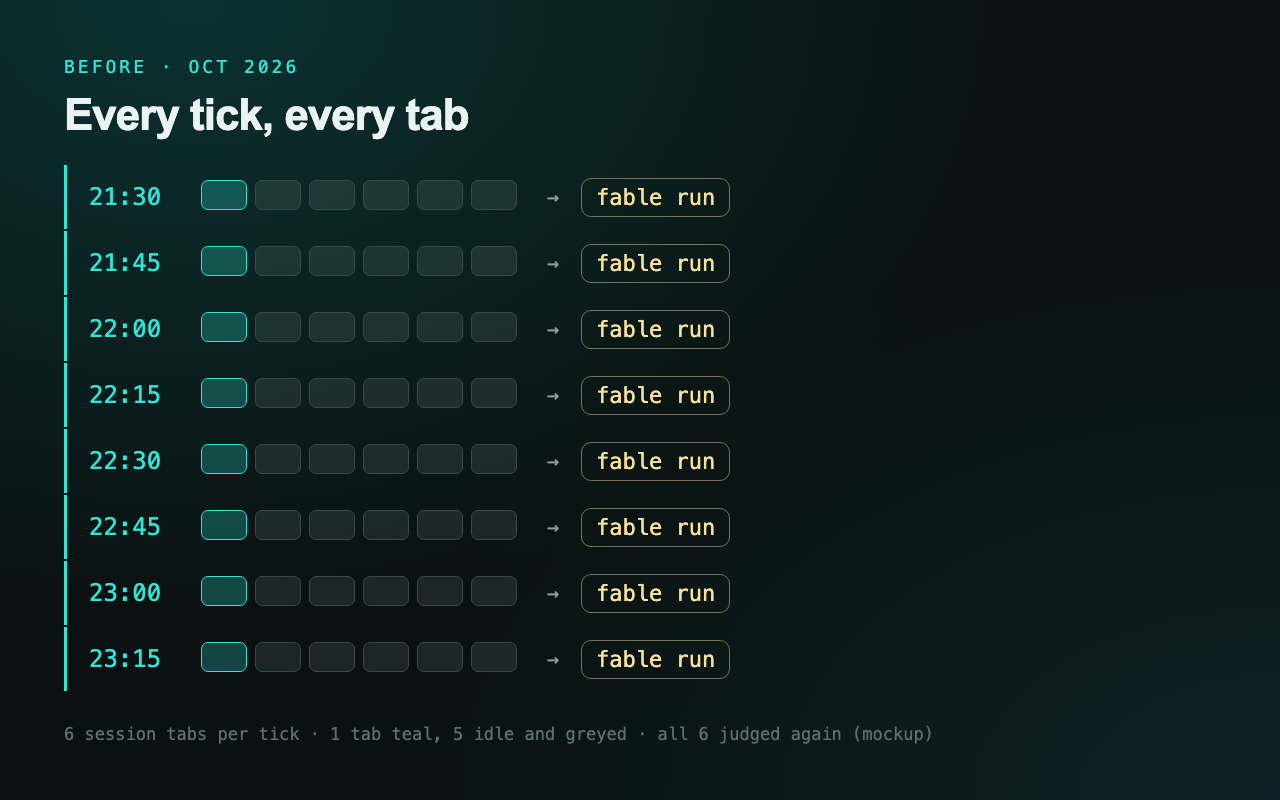
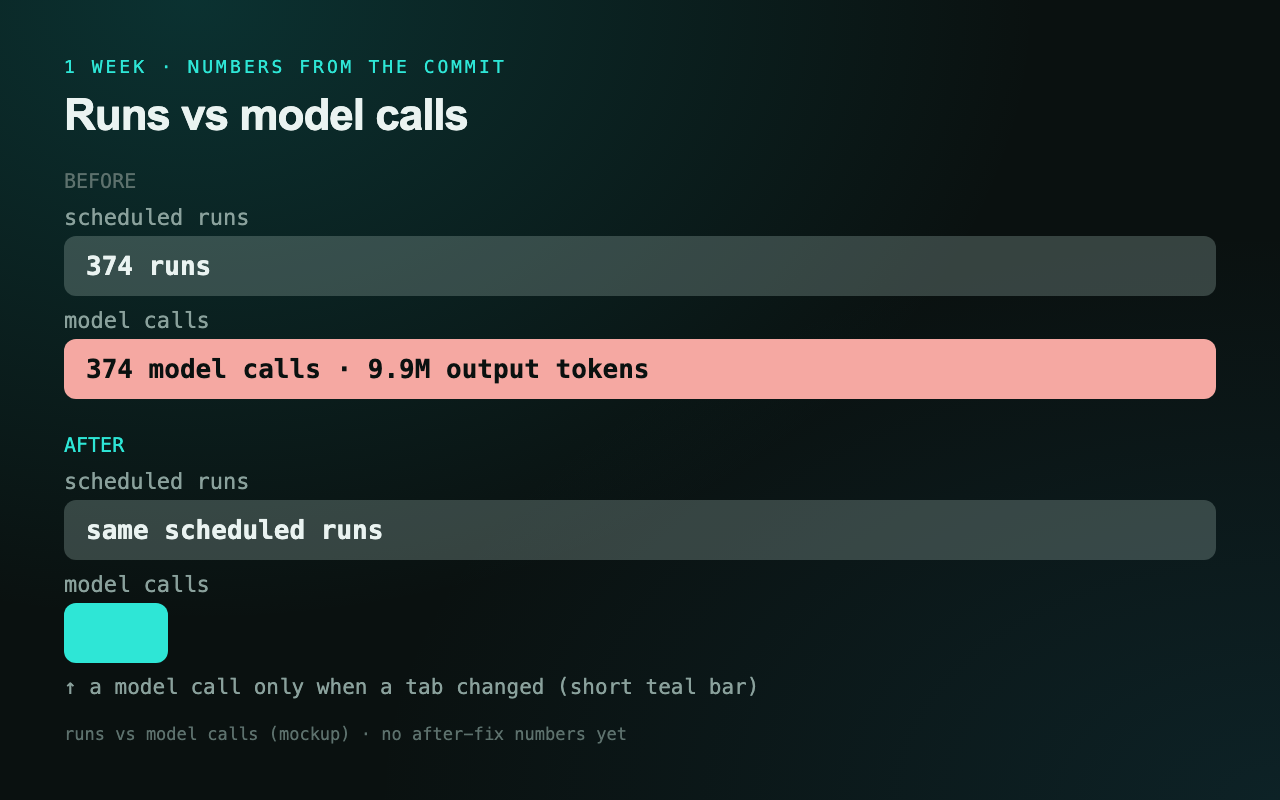
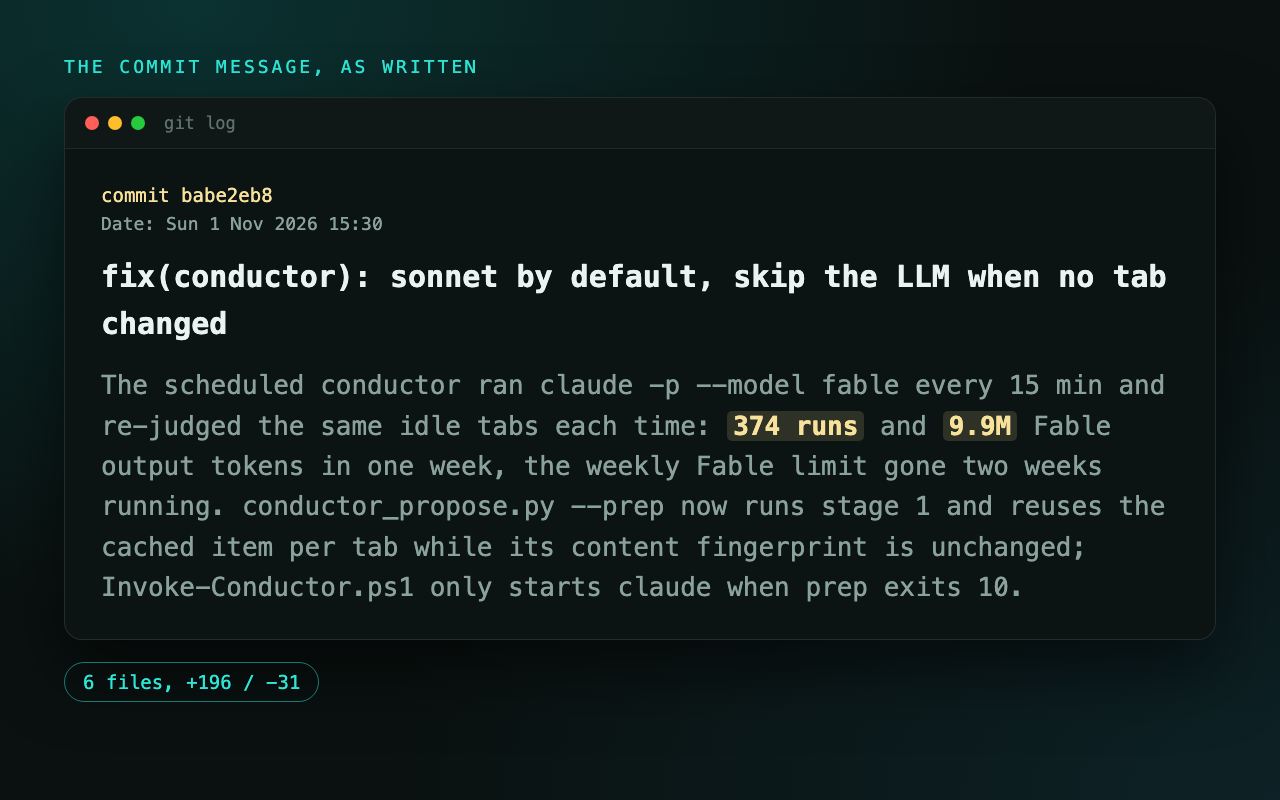
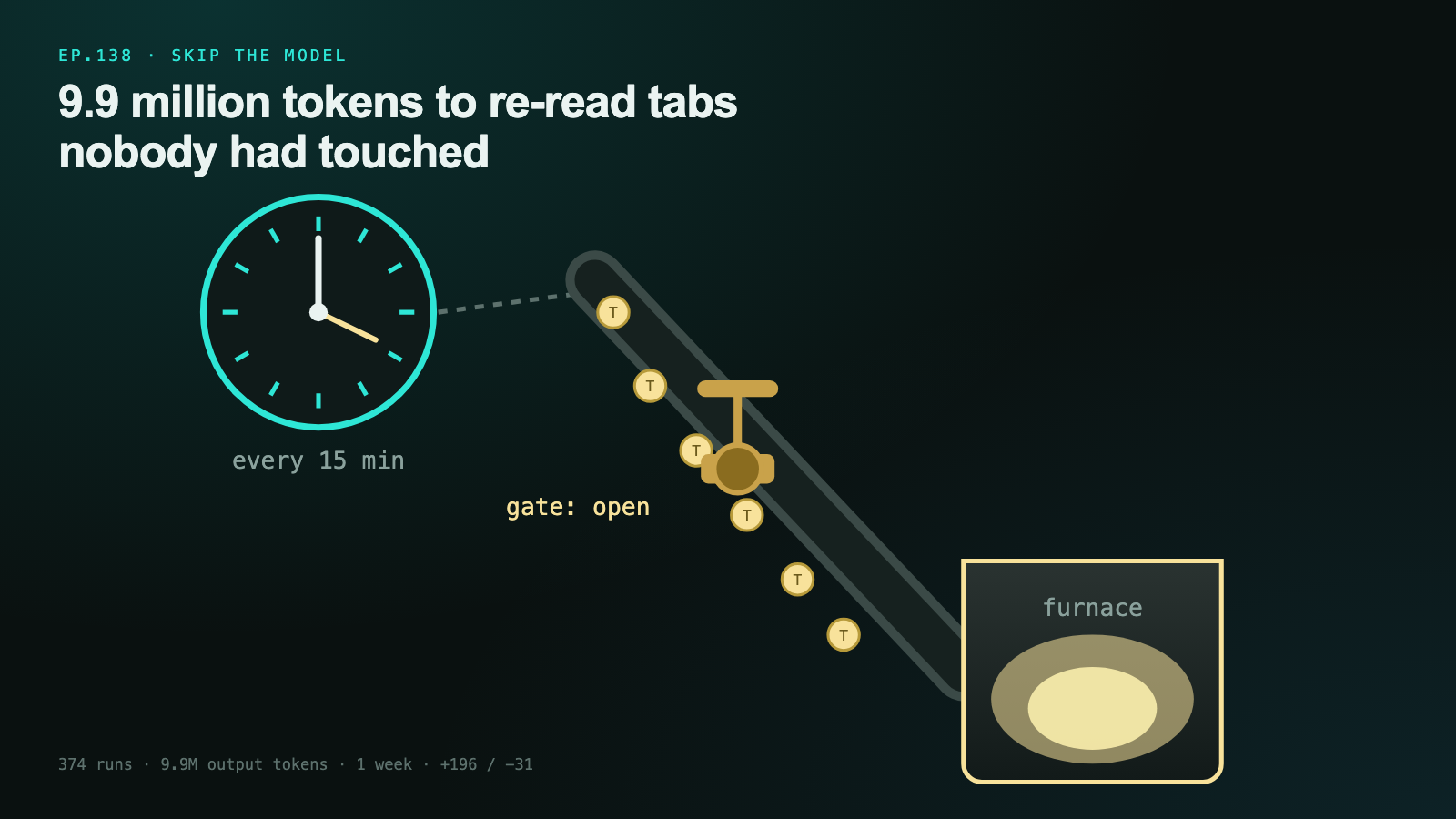
Every 15 minutes a scheduled Claude run read all my open Claude Code tabs and wrote each one a next step. Most of those tabs had not moved since the last run. It judged them again anyway, from scratch, on my top model. In one week that was 374 runs and 9.9 million output tokens, and my weekly Fable limit was gone two weeks in a row. The fix was not a smarter model. It was a question asked before the model: did anything change?
I run a lot of Claude Code tabs at once. Most of them are waiting: on me, on a build, on nothing. In EP.110 I built the conductor to tell me which ones need me. A Windows task, AIOS-Conductor, fires Invoke-Conductor.ps1 every 15 minutes. Stage 1 is plain Python: it reads every open tab, its last prompt, its last reply and its tickets, and applies the cheap rules. Whatever the rules cannot settle goes to a headless claude -p --model fable run, which reads each tab and writes it one proposed next step. Every tab, every run, whether it had moved or not.
The week before the fix the conductor made 374 runs and 9.9 million Fable output tokens. That is about 26,000 output tokens per run, spent mostly on writing the same verdicts again. My weekly Fable limit ran out two weeks running, and the work I actually wanted Fable for queued behind a supervisor. The cause was boring. Most tabs were idle. Their last prompt, last reply and tickets were identical to 15 minutes earlier. The run had no memory of having judged them, so it judged them again, in full, up to 96 times a day.
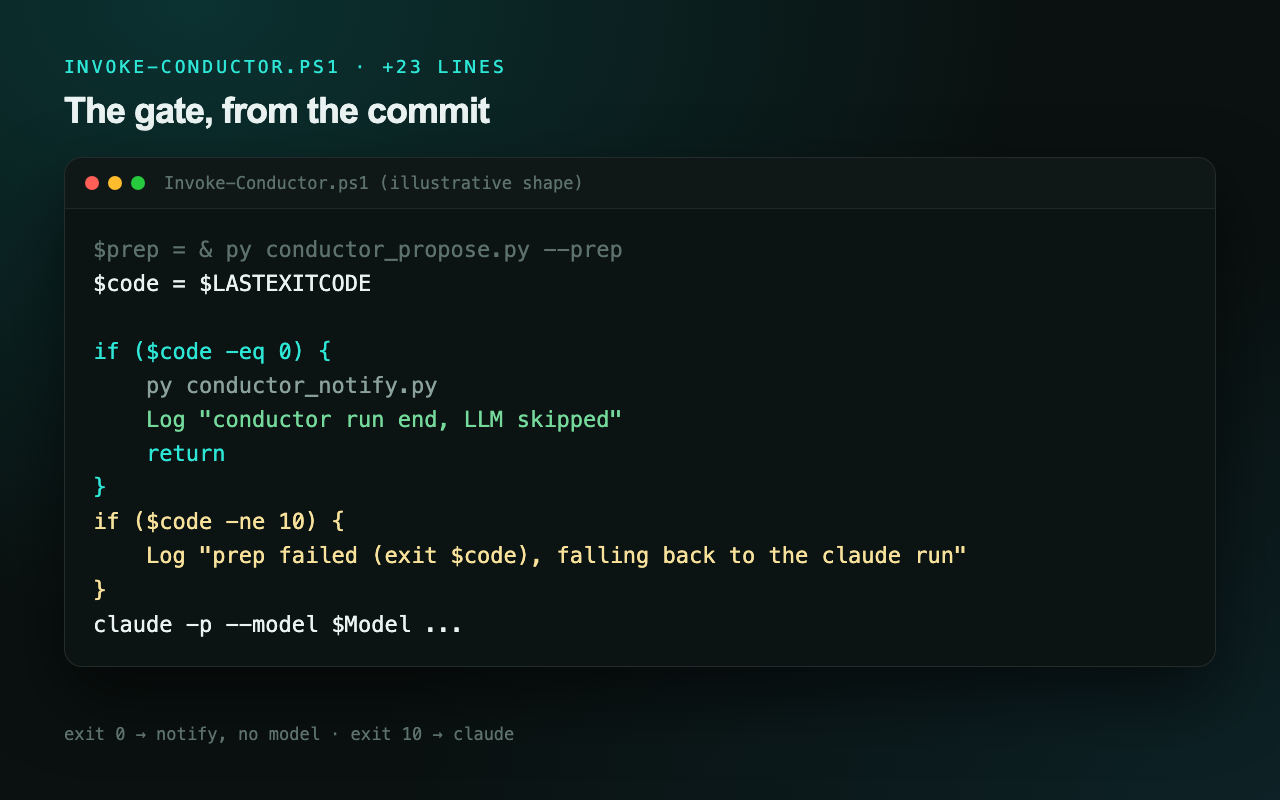
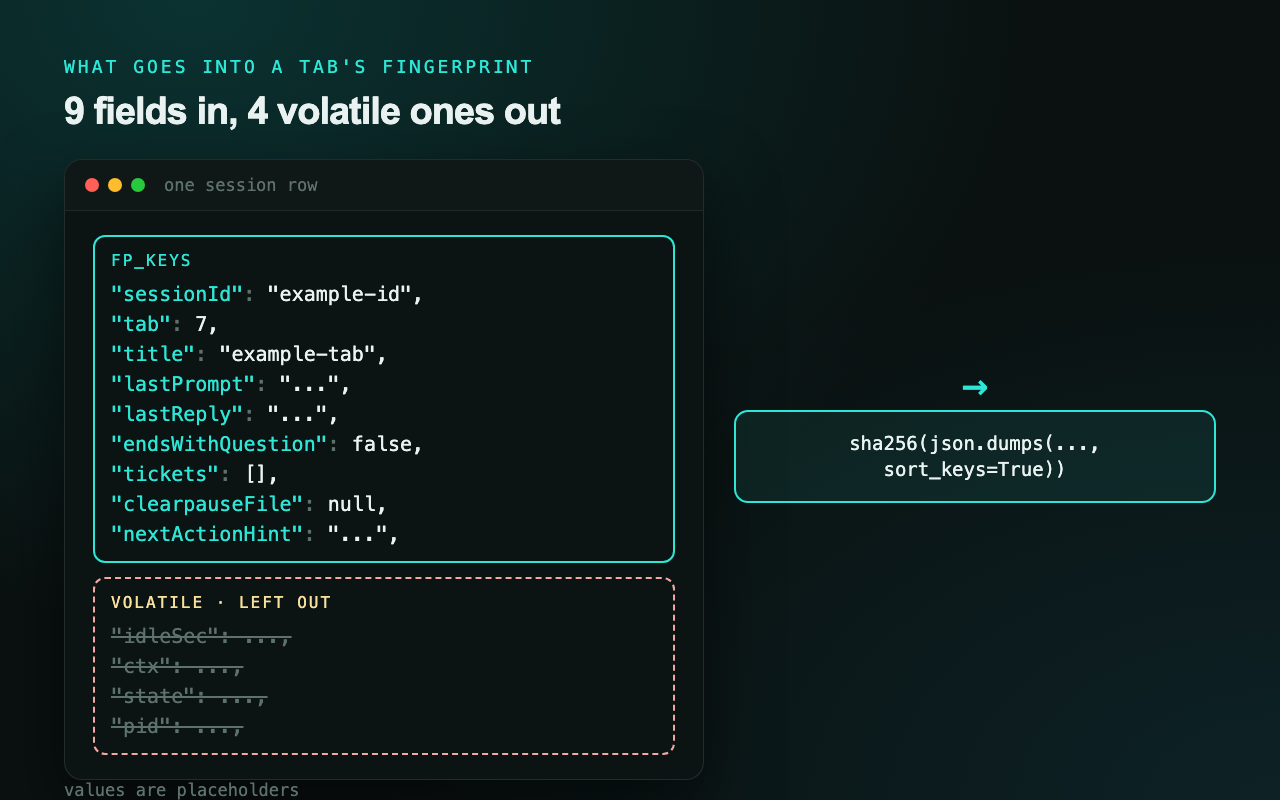
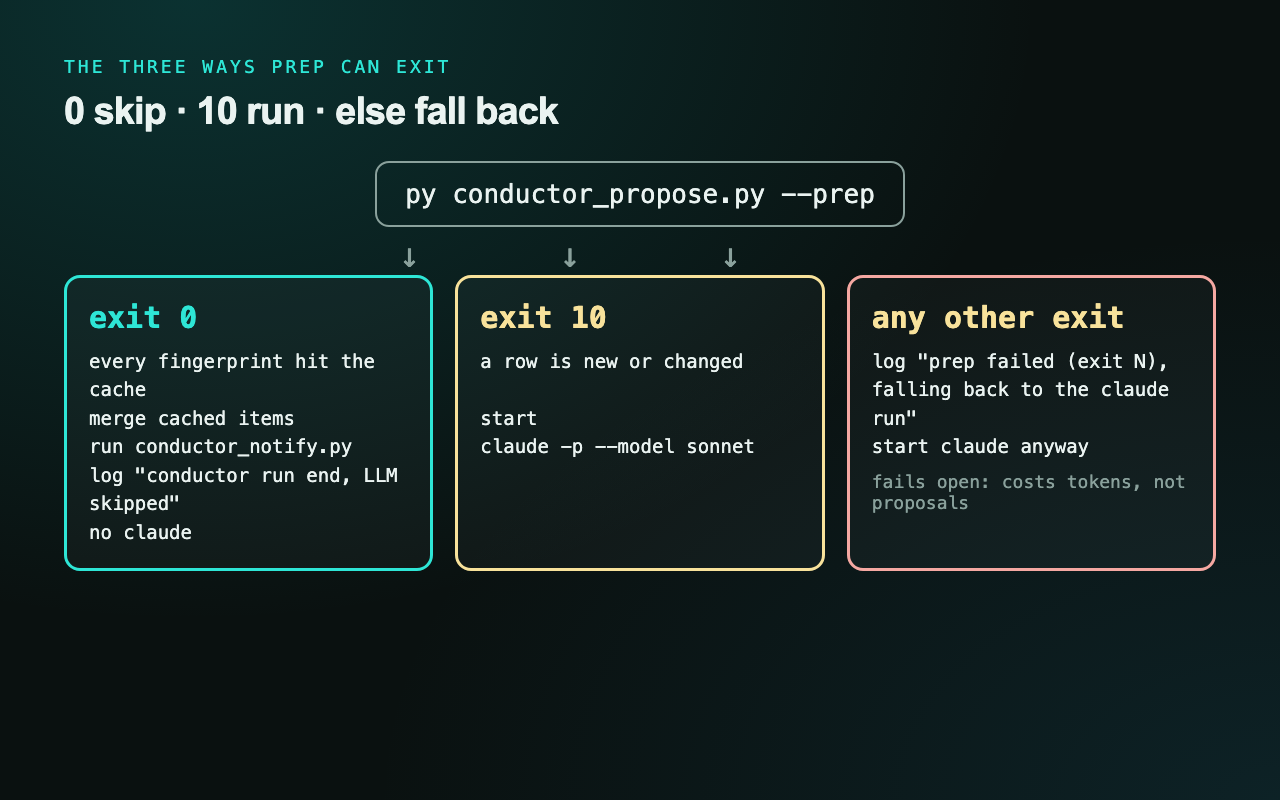
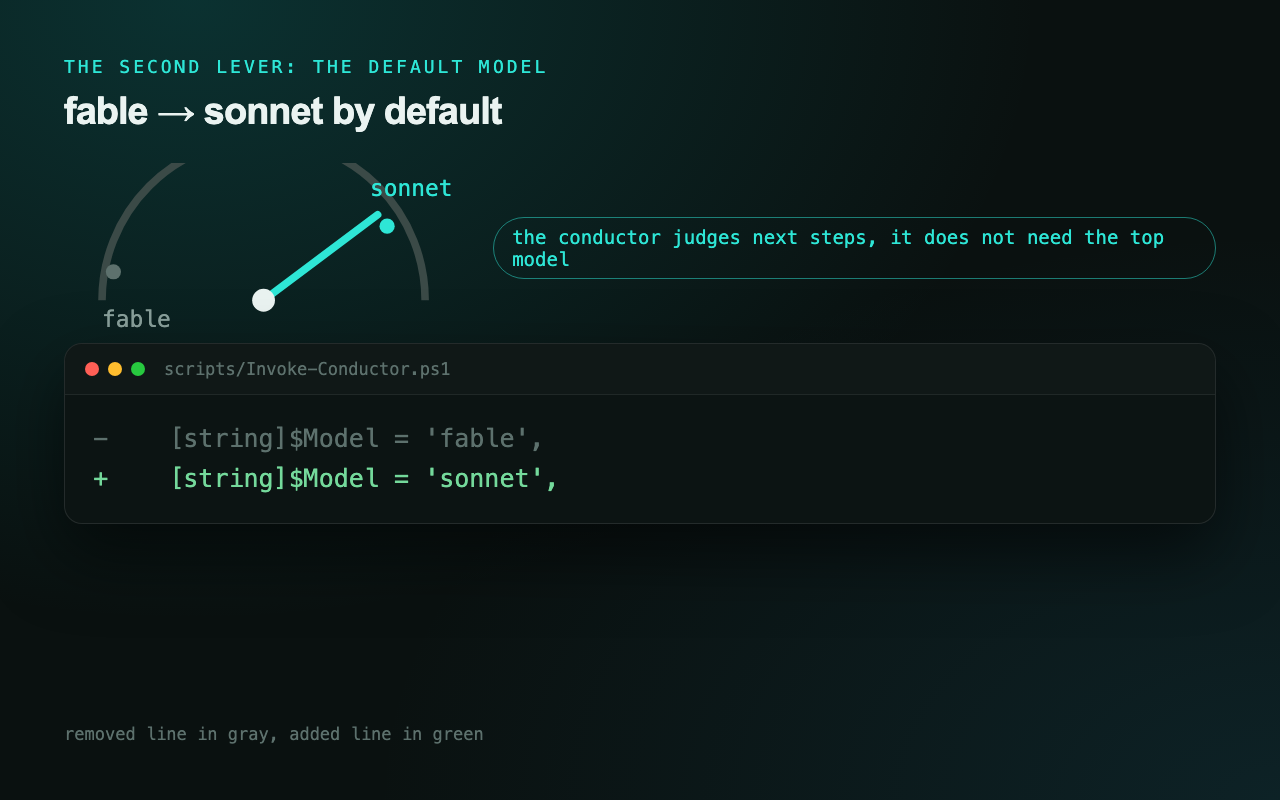
Two small parts. One: conductor_propose.py --prep runs stage 1, then takes a SHA-256 fingerprint of each tab’s row: session id, title, last prompt, last reply, whether it ends with a question, its tickets, its hint. When every fingerprint matches the cache in llm-cache.json, prep reuses the cached items, writes the proposals itself and exits 0. When any tab is new or changed, it exits 10. Two: the launcher only starts claude on 10. On 0 it sends the notification and stops: zero LLM calls. And the default model dropped from Fable to Sonnet, because judging a tab’s next step never needed my top model in the first place.
If the fingerprint covered the whole row, it would change every run, because idleSec grows on its own. So the hash leaves out the volatile fields (idleSec, ctx, state, pid) and keeps only what would change the verdict. Two limits I have not fixed. The gate is all or nothing: one changed tab re-judges every tab in the batch. And the gate fails open: if prep crashes, the run falls back to calling claude, so a bug costs tokens rather than proposals. I have no post-fix numbers yet. The first gated week is the real test.
The whole fix is 196 lines added across six files, most of them in conductor_propose.py and its tests. The pictures below are mockups of the real pieces: which fields go into the fingerprint, what each exit code does, the model default, and the commit that explains it. Tap any image to enlarge it and read the exact prompt that drew it.


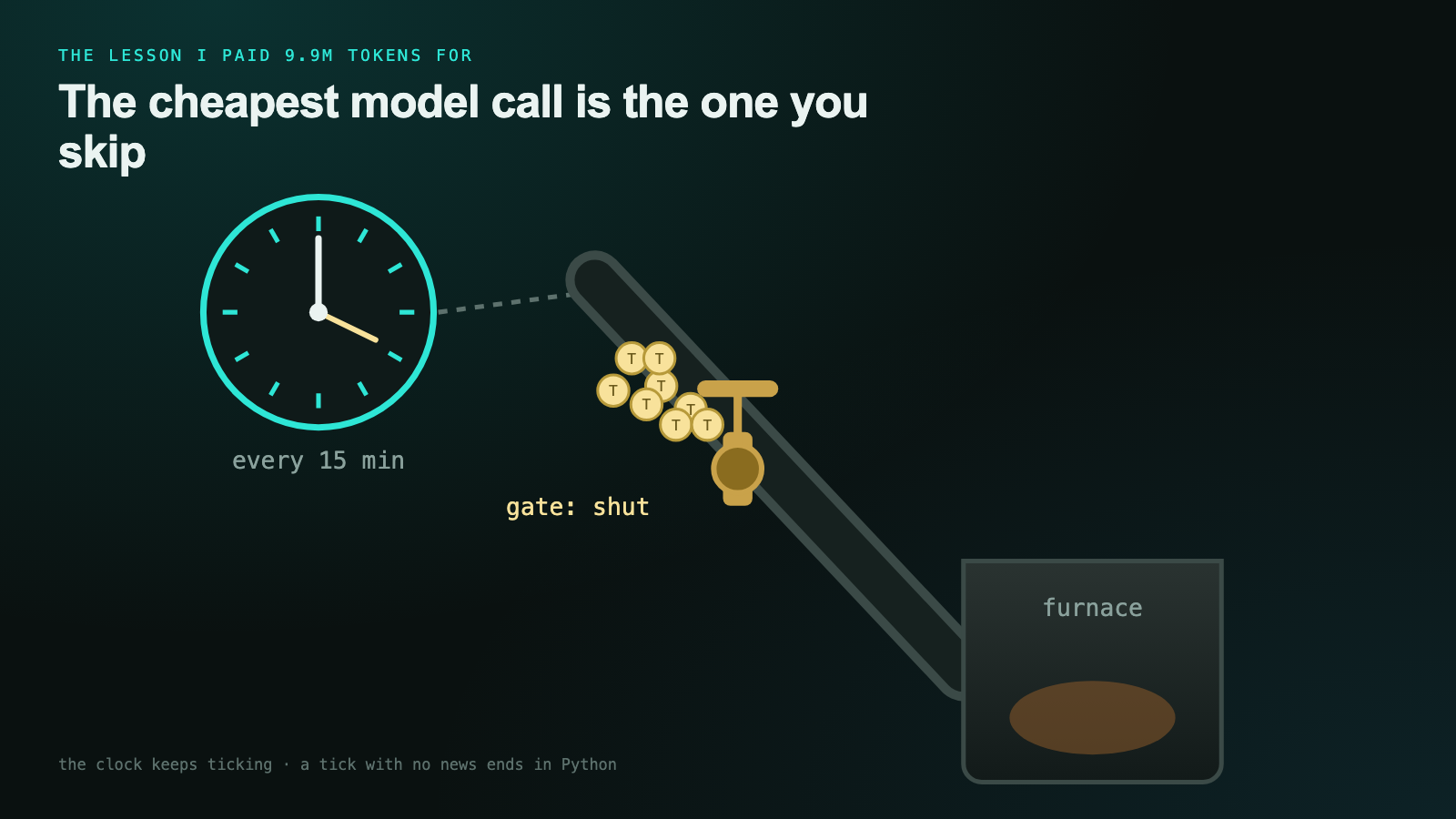
When a scheduled agent costs too much, the first instinct is a cheaper model or a shorter prompt. Both help. But my conductor’s real problem was that it called the model when it had nothing new to say. A scheduler needs a “did anything change?” gate before it needs a smarter model. The clock still ticks every 15 minutes. Now a tick with no news ends in Python.
The token bill, the fingerprint and the exit-code gate in under a minute.
The pattern fits any scheduled agent: fingerprint the input that matters, cache the model’s answer against it, and let a cheap script decide with an exit code whether the model runs at all. Leave the volatile fields out of the hash, and decide up front whether a failed check should fall back to the model or skip it. Everything in this episode is free and open — clone it, run it, make it yours.
# repo soon. The shape: scheduler fires → cheap prep script builds the rows → sha256 of the fields that matter per row → all hit the cache? write cached answers, exit 0, no model → any miss? exit 10 → launcher starts claude -p --model sonnet only on 10 → merge caches each new answer against its row’s fingerprint
No GitHub? Comment GATE on the post and the bot DMs you the link.
The same week another of my tools learned to edit my shell config the careful way: keep a .bak, write the new file in full, then swap it in one move. Next: why a script that edits ~/.zshrc should never leave it half-written.